


Hello everyone and welcome to summer!
In this column, I will be introducing a new concept called the “12 Flower Goddesses”(十二花神 Shí’èr Huā shén). Each goddess is representative of her month’s flower. You can also think of this as each flower’s “birthday month” as it’s been described to me before.

The flower of June, Gardenia jasminoides ‘Kleim’s Hardy’
Gardenias
As we wrap up the month of June, the luscious scent of gardenia and star jasmine continue to perfume the garden. Until now, I’ve still not found someone who dislikes the scent of gardenia. It’s such a classic scent. Although the gardenia is not depicted as the Flower Goddess of June, she is a constant source of grace throughout Lan Su, especially when in bloom, but even just for her dark green evergreen leaves which add structure.
Moreover, thanks to the breeding of Don Kleim in the last thirty years, we can now grow them in the Pacific Northwest as there are varieties like ‘Kleim’s Hardy’ and ‘Frostproof’ which are hardy to Zone 7.
Also, although the scents of star jasmine and gardenia are very similar, they are in completely different plant families. Gardenia, or Cape Jasmine, as it’s also known, gets its name from the jasmine-like scent and the mistaken belief that this lovely garden plant came from the Cape of South Africa. In reality, G. jasminoides came to Europe via the Cape Colony in southern Africa in the 1700s. The cultivated gardenias that were introduced to Britain via Africa came from work that the southern Chinese had been doing for centuries. They simply had a stop-over at the Cape because of trading routes.
Gardenias have been bred in China since the Song Dynasty (960–1279 AD) and their Chinese name is 栀子花 zhī zǐ huā. As expected, the gardenia flower has been painted into history on canvases, porcelain and lacquerware. The seeds are also traditionally used in Chinese medicine as an anti- inflammatory and antipyretic. The ground seed is also used as a topical treatment for skin ailments.

Xu Xi’s sketch of a Gardenia 徐熙《写生栀子》featuring gardenias, bird, and insect from the Five Dynasties Period

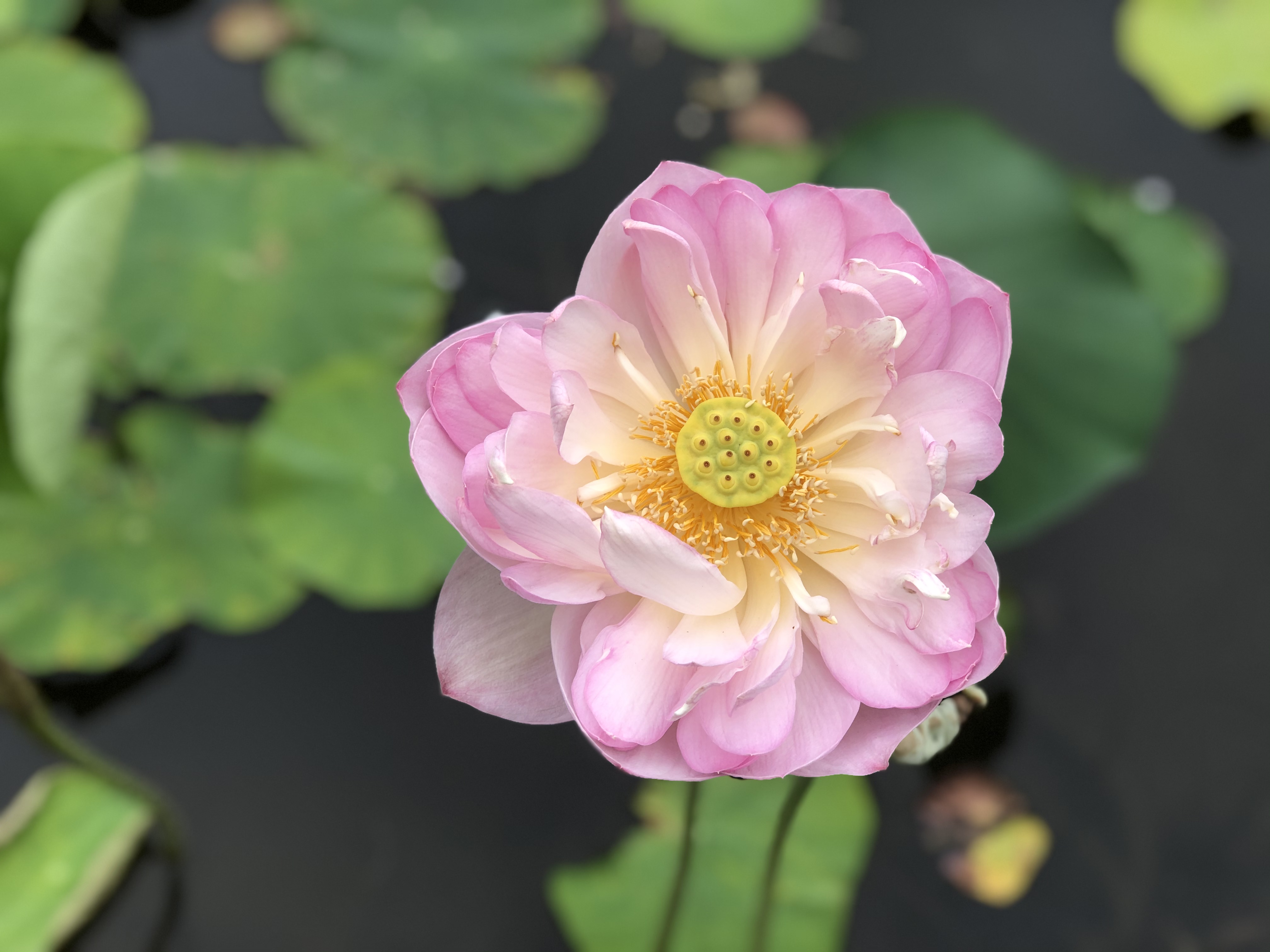
Double pink lotus in Lake Zither at Lan Su Chinese Garden.
Lotus
Now for the true treat of summer: the resplendent lotus! The sixth month of the year belongs to the flower goddess who embodies the lotus. She is elegant and pure. Not only strikingly beautiful, lotus has fragrance too, although hers is much more diminutive than the gardenia’s. July is peak time to view our lotus collection. Lotus vary in color from pinks to yellows to deep magentas and whites.
Each year, the leaves and flower stalks slowly climb from below the mud, up, up, up until they have received enough energy from the sun to start blooming. We have lotus which overwinter in our pond as well as growing in aquatic pots throughout the garden. Our aquatic pots are moved to our greenhouse during the winter so you may notice they have a head start on our pond-planted lotus. But don’t worry, with lots more sun in July and frequent fertilizing, they’ll be in full bloom before long.
Our resident dragonflies love perching on the tops of petals which makes for a very gratifying photo. Dragonflies cannot exist in a habitat without clean water and aquatic plants to forage in and it’s a true honor that we can continue to provide such a habitat. We have enough nooks and crannies that the fish can’t possibly find and eat all the nymphs (which are water-dwelling).

Twelve-Spotted Skimmer (Libellula pulchella) atop a bud


Lotus bloom in Courtyard of Tranquility June 25-26, 2025
I hope you find this series of Flower Goddesses an enchanting topic. I look forward to sharing more about our collection and the biocultural knowledge of these twelve flowers. If I convince even one of you to plant one of these flowers in your own garden, I will consider it a success. Hope to see you soon at Lan Su!
花园见!
Josie
P.S. Watch out for a complementary take on the 12 Flower Goddesses from Venus Sun in her Culture Spotlight column!

Leave a Reply