


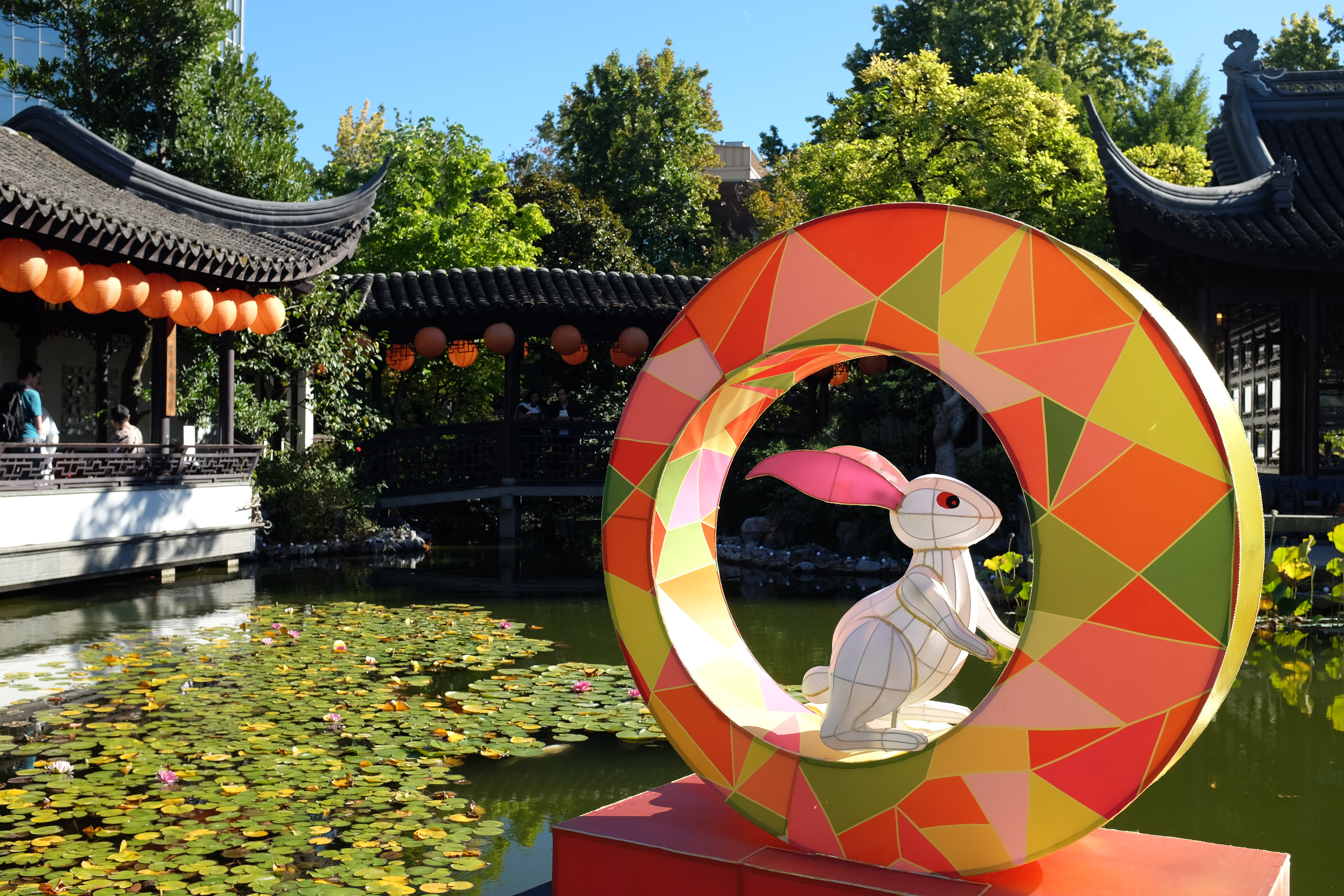
I remember standing outside on Mid-Autumn night as a child, staring at the full moon with my family. My mom pointed to the shadowy patches and whispered, “See? That’s the rabbit pounding away.” I squinted hard, and suddenly the craters looked less like Neil Armstrong’s footprints and more like a bunny with long ears. Once you see it, you can’t unsee it. Of course, my first thought was, “That rabbit has a really tough job—does it ever get a break?”

In the Chinese version of the story, the moon rabbit (月兔, also known as the jade rabbit 玉兔) is more than a pretty picture in the sky. The Jade Emperor once disguised himself as a poor old man and begged food from the animals. The monkey brought fruit, the fox brought fish, but the rabbit had nothing to give. Wanting to help, it leapt into the fire to offer itself. Moved by such sacrifice, the Jade Emperor saved the rabbit and placed it on the moon, where it became the companion of Chang’e (嫦娥), the moon goddess. To this day, it is said to pound herbs with a mortar and pestle, forever mixing the elixir of life.
A late Ming–early Qing dynasty painting depicting the Moon Rabbit accompanying the moon goddess in the Lunar Palace.” Collection of the Smithsonian Institution.
The story has traveled far. During Apollo 11 in 1969, NASA staff joked that the astronauts should watch for Chang’e and her moon rabbit—and Buzz Aldrin replied they’d “keep a close eye out for the bunny girl.”

The rabbit’s role shifts depending on where you are. In Japan, it is known as Tsuki no Usagi, and instead of making medicine, the rabbit pounds rice cakes! In Korea, too, the rabbit is busy pounding rice cakes called ddeok.
Apparently, this is one very hard-working rabbit—if it’s not making medicine, it’s preparing snacks.
In Japan, the moon rabbit is believed to pounding rice cakes instead of making the elixir of life.
Across cultures, the moon rabbit is one of the most beloved Mid-Autumn symbols, second only to the mooncake. It represents generosity, companionship, and the joy of gazing at the same moon with the people you love. For me, it’s also a reminder of childhood wonder: that moment when I looked up and saw, not a distant rock, but a story that connected me to generations across Asia.
This Mid-Autumn, you don’t need to look only at the sky—you can meet real “moon rabbits” here at Lan Su. Thanks to our partnership with Rose City Rabbit Rescue, fuzzy bunny ambassadors will be stationed in the garden noon to 3 PM this Friday, Saturday, and Sunday (September 26-28, 2025) as part of our Mid-Autumn Across Asia festivities to bring the legend to life.
I’ll see you by the (moon) rabbits!
** The story was originated from《玉兔傳說》 (Legend of the Jade Rabbit), which is referenced in 《太平廣記》 (Taiping Guangji, compiled in the Song dynasty, a massive collection of Tang and earlier stories). A similar story was also seen in Japanese folktales.


Venus Sun
Senior Director of Experience
Lan Su Chinese Garden
Leave a Reply