


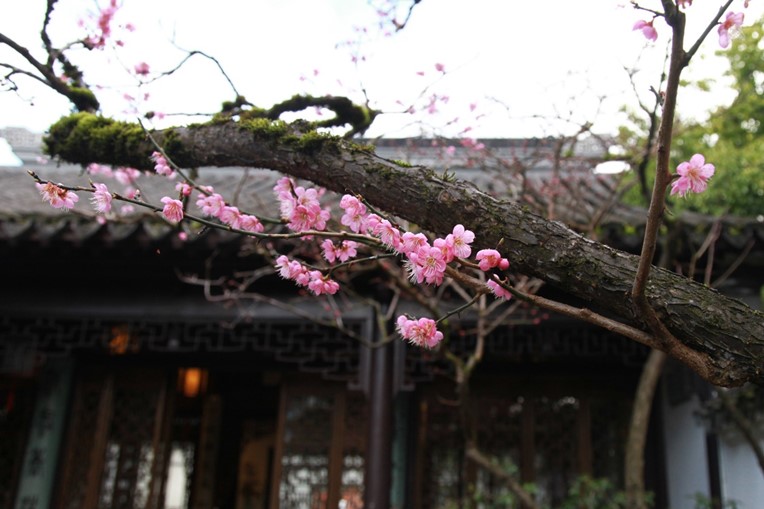
Plum blossoms burst into bloom on leafless branches, Scholar’s Courtyard
Looking for Josie’s most recent post? Read the March Hort Tidbit.
“The moonlight of a former time,
How often has it shone on me?—
I play on a flute by the plum tree,
Awakening the fair one
To pluck a sprig, defying the chill!”
Dim Fragrance, Jiang Kui circa 1191 AD
舊時月色,
算幾番照我,
梅邊吹笛?
喚起玉人,
不管清寒與攀摘。
暗香,姜葵,1191年
There is arguably no flower more iconic to the Chinese than the plum, Prunus mume. Its reference is repeated throughout art, poetry, and gardening for over a millennia. Its awe-inspiring life cycle of blooming on bare branches has solidified its reputation as the floral pinnacle of enduring hardship. Ancient specimens, up to 1,000 years old in China, assume a crooked and gnarled appearance but still produce flowers and young green shoots, suggesting that from age there may still come the joys of youth (Chinese Floral Symbolism, 1952).

Plum penjing, Hangzhou Botanical Garden’s Lingfeng Plum Garden, photo credit to my father-in-law, Yonglin Lu
Its bloom time in midwinter calls to mind the coming spring and it is often seen as a symbol of hope amongst the frigid landscape. There is a practice stemming from long ago in which, starting at the winter solstice, families would paint a plum branch and add one plum blossom each day through the 81 coldest days of the year. When all 81 blossoms were complete, it signaled the first day of spring. In fact, the motif of plum blossoms on cracked ice is common on ginger jars and blue vases as well as within the mosaic pathways of Suzhou gardens (and our very own!)

冰裂梅花紋 Plum Blossoms on Cracked Ice mosaic, Scholar’s Courtyard, on a sunny day during Lunar New Year
You will simply not find a Suzhou scholar’s garden without plum trees. Their cultivated history is woven not only into scholarly culture and art, but the very identity of China. It was chosen as the national flower in 1928 with the idea that the five petals of the bloom represented the five main ethnic groups of the country (Han, Manchu, Mongol, Hui, and Tibetan) as well as the then Nationalist Party’s Five Power Constitution. During the Cultural Revolution and the Republic of China’s move to Taiwan, the plum as the national identity also moved to Taiwan and was lost in China. Nevertheless, this tree, indigenous to the Chinese mainland, has remained near and dear to the hearts of the Chinese.
The five petals are emblematic of the five blessings (五幸) – old age, wealth, health, love of virtue, and a peaceful death. Many other Prunus species have five petals (apricot, cherry, and peach to name a few) so why are plums regarded so highly? Perhaps it is due to their ability to display perseverance through hardship, but maybe it is also due to the fact that plums were cultivated for their fruit far before they were planted as an ornamental.
The fruit is acidic and sour before it is completely ripe and that’s often when it is harvested—to preserve those exact characteristics. It is commonly pickled whole in either salt or sugar (or even honey, which is delicious!). If you have eaten Japanese umeboshi before, you may be very familiar with the refreshingly sour taste. Plum sauce (酸梅醬), a staple Cantonese dipping sauce, may also be a flavor you’re familiar with (although unsurprisingly American plum sauces tend to be much sweeter than their Chinese counterparts). Plum sauce is also widely known as “duck sauce” as it is often served alongside Peking roast duck. Plum wine (青梅酒) is also highly coveted and a fantastically delicious drink found all around East Asia.
Plums have medicinal properties as well. They are neutral in nature in Traditional Chinese Medicine terms, which means they neither “add heat” nor “cool” the body. This balance of Yin-Yang is key to keeping the body healthy. Their key characteristic is digestive aid. This explains why plum sauce came to be served alongside rich and oily foods. Not only does the slightly sour flavor cut through the richness, it actually helps our body to better digest it.

Prunus m. ‘Peggy Clarke’ in bloom, February 2025
Whether you admire the plum most for its symbolism, its beautiful stature, its fragrance when in bloom, its sour fruits, or its ability to help stabilize the body, it is a deeply respected plant which is best appreciated in midwinter. Our collection contains Prunus mume as well as multiple cultivars of it which means that we have a bloom time which ranges from January through March.
As of writing, we also still have some large 1-gallon specimens of various plum varieties available at our Garden Shop for purchase. So whether you’re in awe of our classic white plum in the Plaza or are a fan of the double-flowered pinks, there’s a variety for you! (I was personally very excited to bring in the rarely seen ‘Hokkai Bungo’ which is a deep magenta.) Happy plum season and see you in the garden! 花園見!

Josie Losh
Curator of Horticulture
Lan Su Chinese Garden
Leave a Reply