

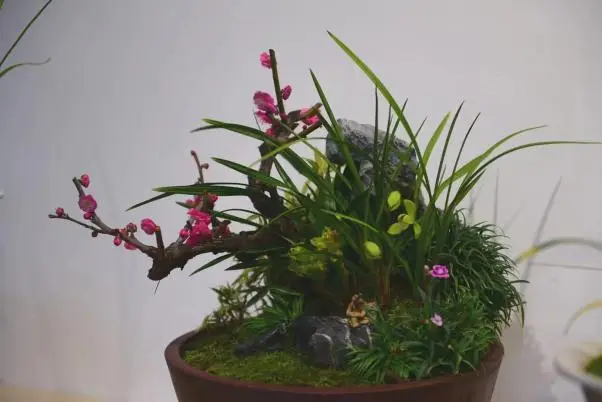
A cymbidium orchid (green flowers) blooms in a penjing display alongside a Chinese plum tree, dianthus and dwarf mondo grass. If you look very closely, you can spot a mudman as well. This photo was taken in China.
March ushers in the true beginning of spring for the Northern Hemisphere. The volume of blooms unfolding on a daily basis allows us northwesterners to feel like there’s an end in sight to cold gray days. Indeed, already the amount of daylight we have at 5:30 PM feels entirely like a treat.
Chinese Orchids at Lan Su
Amongst the camellias, paperbush, daphne, and magnolia blooms of the garden—which are full of color and fragrance—the demure Cymbidium orchid reveals its understated beauty. Found within the garden mostly potted into slender, specialty orchid pots from Suzhou, these temperate orchids look, to the inexperienced eye, like an ornamental grass.
Even more elusive are the several specimens we have been trialing in-ground planting of. If you can find those within our garden beds, I really applaud you on your botanical skillset. The texture of the leaves is different, but the color and width of each blade really resembles lilyturf, which is planted en masse throughout the garden. It’s akin to searching for a needle in a haystack!
Why Orchids Are So Special to Us
Our botanical collection encompasses two main types of orchids: ground orchids (Bletilla species) and Cymbidiums. The latter are one of the oldest orchids known to human cultivation. There is recorded evidence that they have been cultivated since at least the Jin Dynasty (200 CE). With such a long history, it should come as no surprise that they are a treasured plant to China. As a whole, they are termed 國蘭 (guolan) or “The Nation’s Orchid.”
This brings us to a very fun fact! The word orchid 蘭lán is part of the set of characters in the transliteration of Portland in Chinese: 波特蘭 Bō tè lán. As Lan Su is an amalgamation of 波特蘭 Bō tè lán + 蘇州 Sūzhōu (=蘭蘇) to represent our sister city relationship, orchids have become our namesake!


Potted orchids within a hall of the Master of the Nets Garden, Suzhou (our sister garden)
Cymbidium longibracteum 隆昌素’Long Chang Su’ in bloom at the Yun Shui Teahouse
If you are looking for these orchids at Lan Su and don’t feel like going on a hunt, I encourage you to visit the second floor of the Yun Shui Teahouse. On the south side of the Teahouse, flanking both the east and west corners, are slender tables which I had commissioned while Yun Shui was under renovation specifically to hold orchids. These tables receive the perfect amount of sunlight for Cymbidium species in our collection. They thrive on mostly bright indirect light.
Cymbidium Orchid Traits & Growth
In bloom, Cymbidiums have a sophisticated feel. Unlike many orchids which come in an array of flamboyant colors with extra-large blooms, Cymbidiums come in soft tones of green, yellow, white, pink, and orange. The labellum, or “lip” petal of the orchid is often a different shape and a contrasting color from the other petals. This helps their pollinators “find” where the pollen is located. They also have wonderful fragrance which I liken to cologne more than perfume. It is subtle and refined, and you must be in close proximity to smell it.
As a genus, Cymbidium orchids inhabit a range of climes from tropical to temperate. Many of the shorter, smaller leaved species are native to high altitude environments in China and thus grow well in our temperate PNW ecosystem.

Cymbidium ensifolium for sale in the Gusu District, Suzhou
Tips for Growing Potted Cymbidium Orchids
In their natural habitat, they are epiphytic (growing on another plant) or lithophytic (growing on rock). Therefore, in cultivated conditions, they need an extremely free-draining potting mix. After consultation with a Cymbidum expert several years ago, our horticulture team has found that a combination of large pumice, large kanuma, akadama, and pine bark make a nice, chunky substrate for potting them in. If you are seeking out a suitable pot, make sure it is tall to accommodate the long roots and has a very large drainage hole.
I must admit, the Cymbidium orchid is not an orchid for beginners. Even with a careful pattern of fertilizing, watering, and adjusting growing conditions, I have been perplexed by how to bring the perfect conditions about to encourage blooms. But when they do bloom, it is such a joy to experience our garden’s namesake in its full glory!

Josie Losh
Curator of Horticulture
Lan Su Chinese Garden

Leave a Reply