
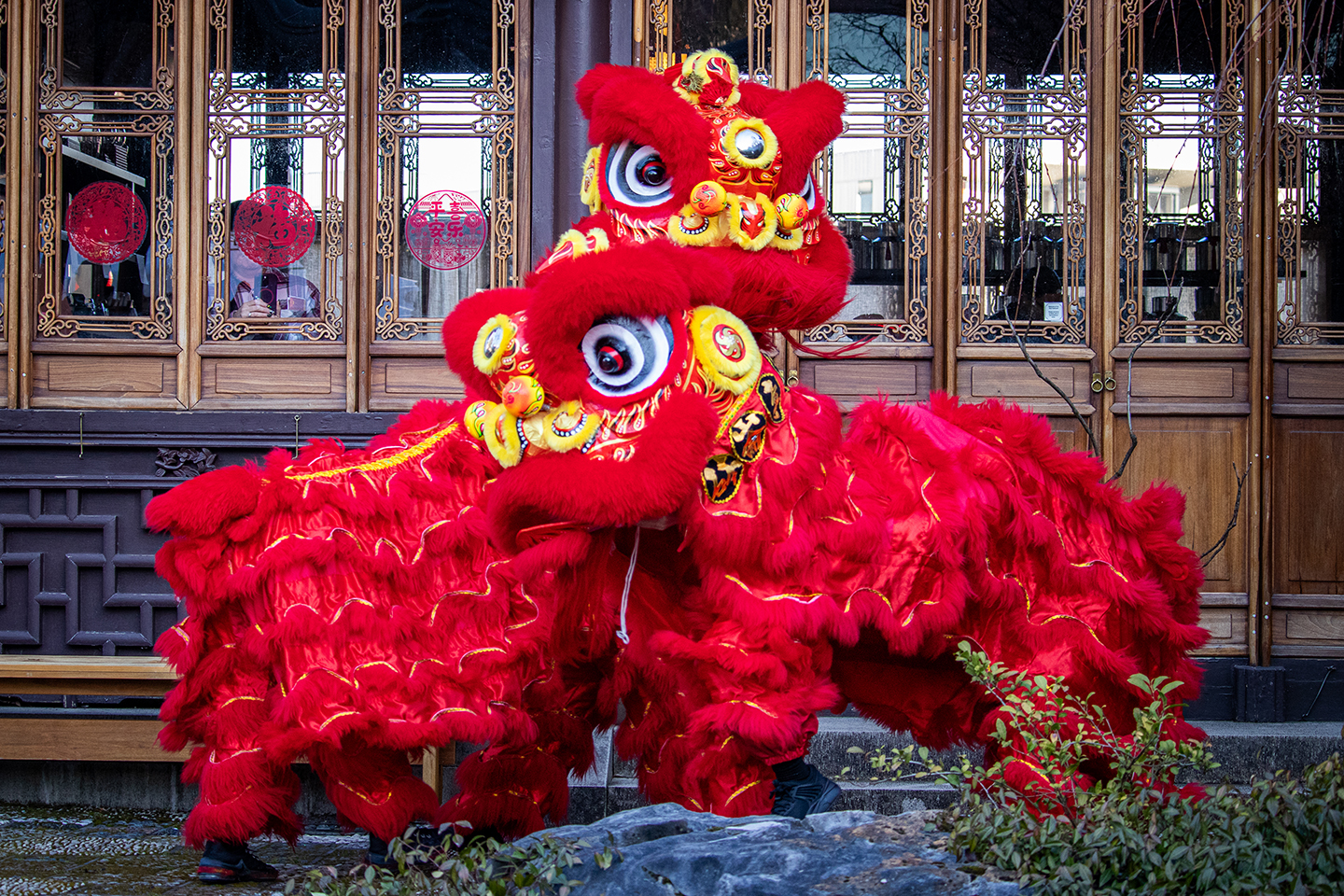
You know what’s funny? I spent the first 25 years of my life in Taiwan and never once saw a lion dance live.
Did I know what lion dance was? Of course. I saw it in movies and on TV. (My personal favorite lion dance movie: Once Upon a Time in China III from 1992!) It was something that felt familiar, part of Chinese culture I recognized without ever really experiencing it.
Then I started working at Lan Su.
I still remember my first Lunar New Year here, more than ten years ago, when I heard those drumbeats in person for the first time. You don’t just hear a lion dance drum. You feel it. The sound travels through your chest, and suddenly there is a lion leaping, blinking, shaking its head, and coming right at you.
I was a program coordinator then, and one of my responsibilities was to lead the lions around Lake Zither. (A pretty great work perk, if you ask me.) I remember visitors, some who looked like me and many who didn’t, completely mesmerized. Children’s eyes sparkled. Laughter followed the lions around the garden.
That memory has stayed with me.
Why do Chinese lions look like that?
The Chinese lion itself has a fascinating story. Lions aren’t native to China. They arrived through exchanges with Central and Western Asia, including as exotic gifts to the imperial court during the Han dynasty (206 BCE–220 CE). From there, generations of Chinese imagination did the rest.
That’s why Chinese guardian lions don’t exactly look like lions at the zoo. They became something else: part lion, part imagination, part protector. Over centuries, they came to represent safety, strength, prosperity, and good fortune. You can find them guarding Lan Su, too.


I love that about cultural symbols. We encountered an animal most people had never seen, imagined our own version of it, and turned it into a magical protector.
Who says Chinese people aren’t creative or romantic?
Now, what does any of this have to do with kung fu?
Quite a lot, actually.
What do lions have to do with kung fu?
Southern, or Cantonese, lion dance has been connected to martial arts for centuries, with traditions in Guangdong dating back at least to the Ming dynasty (1368–1644). By the Qing dynasty (1644–1911), lion dance and martial arts schools had become closely intertwined.
There are even stories that when Qing authorities became suspicious of martial arts groups and potential uprisings, lion dance gave practitioners a much friendlier-looking way to gather and practice their skills. After all, what could possibly be threatening about a giant fuzzy lion?
Look underneath the fur, though, and the kung fu is still there: the stances, footwork, balance, strength, and coordination.
Then the lion traveled again.
Beginning in the mid-1800s, immigrants from southern China carried lion dance and martial arts traditions overseas. They took root in Chinatowns and Chinese communities across the United States and eventually throughout the Chinese diaspora.
That is why I decided to present our very first Lion Dance & Kung Fu Weekends, this August 28-30 and September 4-6. I’d like to show you that there are so much more than just the performances.
Lion Dance & Kung Fu Weekends at Lan Su | August 28-30 & September 4-6

Across six days, you can watch lion dance and martial arts performances and demonstrations, but also try them yourself. Workshops introduce the movements, rhythms, and instruments that bring the lion to life.
Perhaps what I’m most excited about is meeting the people behind the lion.
Our Meet the Lion Dancers & Martial Artists conversations offer a rare opportunity to sit down with Portland lion dance coaches, dancers, martial artists, and me. Who are the people carrying these traditions forward today? How did they get involved? What does this tradition mean to them?
After more than ten years at Lan Su, I’ve watched this community grow and literally grow up with us. Somehow the dancers seem to get younger every year. It can’t possibly be that I’m getting older, right?
Lion Reborn Art Exhibit on display through November 1

The celebration also coincides with Lion Reborn, featuring local Chinese American artists Joshua Sin and Lark Pien, inviting us to see this centuries-old tradition through a contemporary lens.
That combination is intentional.
Lion dance has never stood still. It grew from imagination, evolved through ritual and martial arts, traveled across oceans with Chinese communities, and continues to be reshaped by every generation that carries it forward.
So this year, I hope you don’t just watch the lion. Meet the people inside it. Learn its movements. Feel its drumbeats. Discover its history and community. See it reimagined through art.
Most of all, I hope you feel some of what I felt beside Lake Zither all those years ago. Maybe the drums will catch you by surprise. Maybe you’ll find yourself following the lion around the garden. Maybe you’ll see a child’s eyes light up, or realize that yours have too.
Sometimes a tradition you think you already know can still surprise you.
It certainly surprised me.
Hope to see you soon at Lan Su!


Venus Sun
Senior Director of Experience
Lan Su Chinese Garden
Featured photo at top by Aileen Sheedy

Lion Dance & Kung Fu Weekends
August 28-30 & September 4-6
Join us for two action-packed weekends filled with lion dance performances, workshops, and family-friendly arts & crafts. Learn how kung fu shapes lion dance movements, meet the dancers behind the lions, and get creative with hands-on activities.
Leave a Reply