
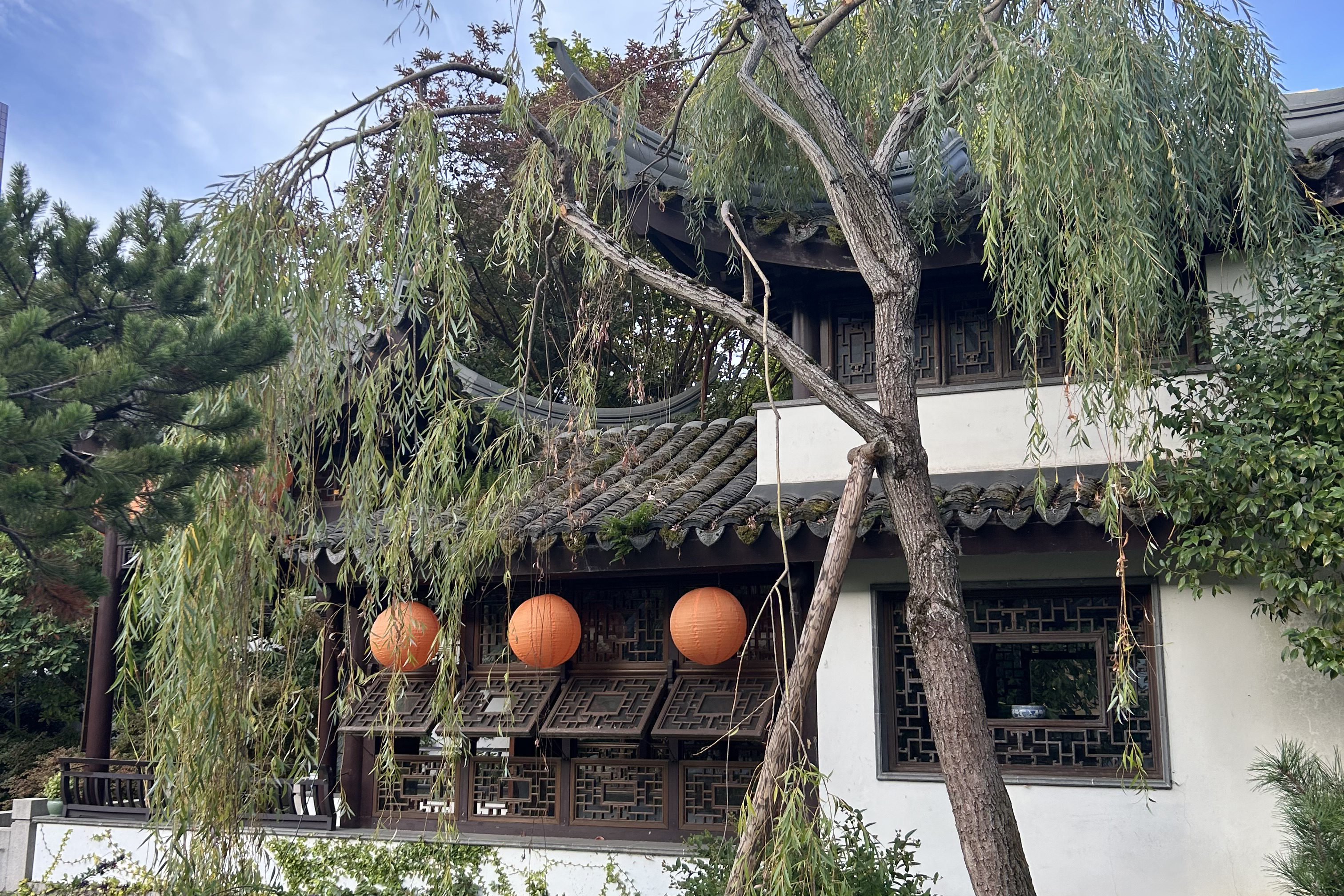
Our willow ‘Niobe’ is sporting a much different look than normal as we try to reduce the pest pressure it’s currently experiencing.
The past two summers, our dear weeping willow next to the Painted Boat in Misty Rain has experienced a fair amount of dieback of tertiary branches. Though I had summed up the dieback to drought stress, as willows famously cannot get enough water, mid-summer we discovered a substantial infestation of oystershell scale on the tree.

Oystershell scale are very small, only 1/8th of an inch at maturity, and easily blend in with the texture and color of many tree barks (photo from University of Kentucky College of Agriculture).
Oystershell scale, a type of armored scale, frequently causes injury to both native and ornamental trees and shrubs and lilac, ash, dogwood, maple, poplar, and willow are most frequently affected. Limbs become weakened when the scale insects pierce their mouthparts into the branch and remove fluid. Key indicators are yellowing leaves and branch dieback.
Luckily, once we found out the cause of our tree’s stress, we got straight to work removing the most affected branches. Although this alone is not enough to return to the willow to its prior vigor, this was key to reducing the scale population significantly.


A close-up on upper limbs of our weeping willow. Although they camouflage well against the striated gray bark of mature limbs, the severity of the scale infestation is apparent on the young yellow branches.
As per our system of IPM (Integrated Pest Management) that we operate by at Lan Su, we will pursue treatment of the willow going forward with manual removal and application of insecticidal soaps or horticultural oils that have the least amount of impact on the surrounding environment. With the willow surrounded by water, we need to take extreme care even with organic methods of treatment because fish are extremely sensitive.
As any gardener knows, there are times when a certain realization of a pest problem seems to consume your mental capacity. Especially when that pest is pervasive and not susceptible to common tools used in other interventions. You have to strategize, do research, and sometimes test things out. Luckily, oystershell scale only has one generation per year. We have a great chance at reducing the population load so that it is no longer impacting the tree’s vigor. I expect the tree will be able to flush out new branches next spring. In the meantime, rest assured that Lan Su’s Horticulture team is doing everything we can to help out our willow!
Looking forward to seeing you in the garden soon,

Josie Losh
Curator of Horticulture
Lan Su Chinese Garden
Leave a Reply