
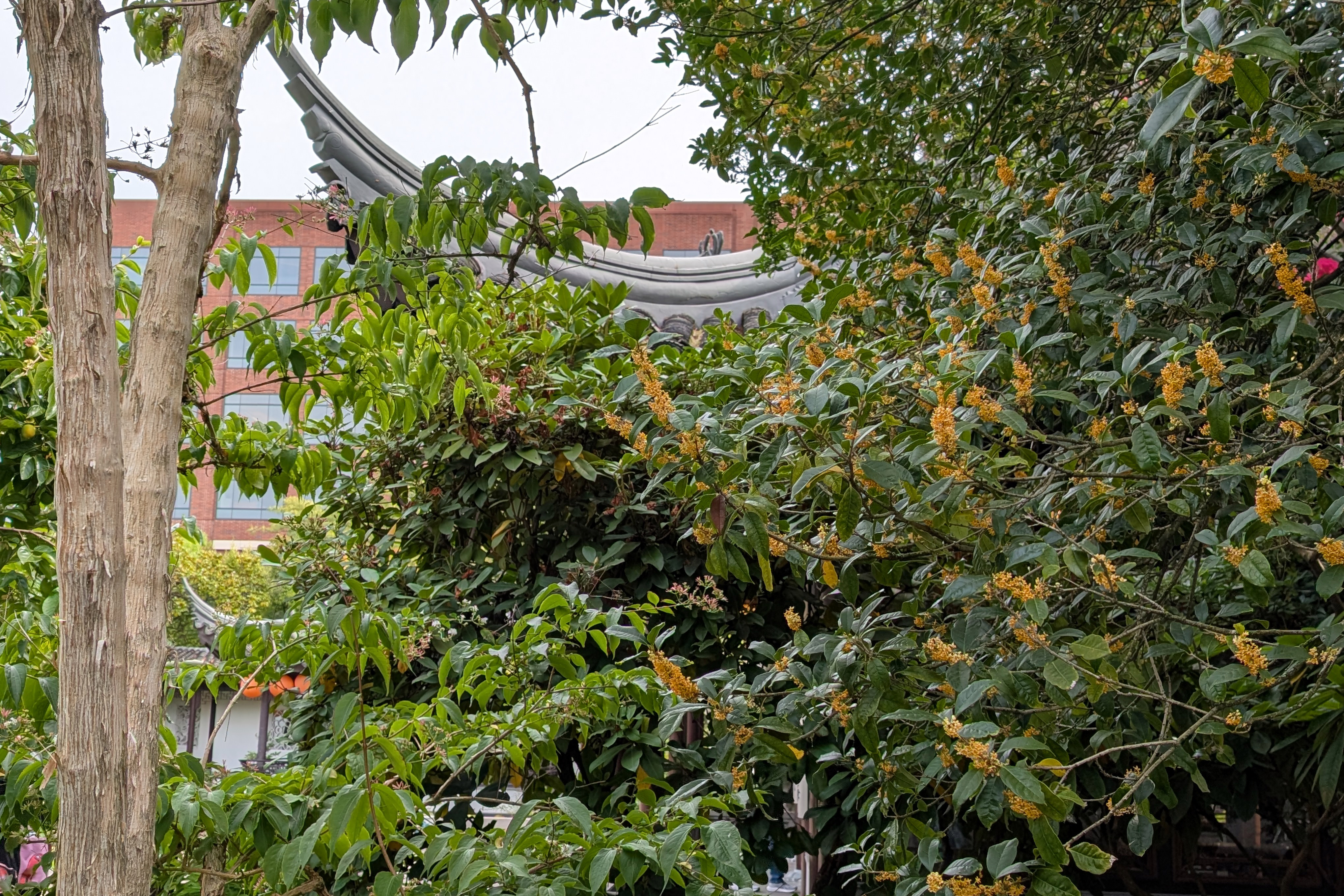
Golden osmanthus frangrans in bloom at Lan Su Chinese Garden next to the Hall of Brocade Clouds (September 2026)
Some of my earliest memories have a scent.
When I was little, my mother worked during the week, and my godmother cared for me at her home in Wulai (烏來), a mountain town outside Taipei known for its hot springs and lush natural scenery. Every autumn, the sweet fragrance of osmanthus would mingle with the warm steam rising from the hot springs. Even now, one breath of osmanthus can transport me instantly back there.
My godmother and I had a favorite autumn ritual. We would stand beneath the osmanthus shrubs and shake the branches, waiting for what I called “osmanthus rain”—hundreds of tiny, fragrant yellow and white blossoms fluttering onto my hair and clothes. We gathered the fallen flowers and brought them home, where they found their way into steamed cakes and jars of fragrant osmanthus honey.
For such a tiny flower, osmanthus (桂花, guìhuā) leaves a remarkably large impression.
An evergreen tree or shrub, osmanthus produces masses of tiny flowers: white, pale yellow, golden, or orange. I particularly adore their sweet fragrance, far more powerful than their size suggests. In China, that unmistakable scent has announced the arrival of autumn for centuries, finding its way into gardens, poetry, tea, sweets, wine, art, and even mythology.

Orange osmanthus fragrans in Lan Su Chinese Garden. The “fragrans” in it’s name comes from it’s iconic scent that is fruity, sweet, and warm.
The Legend of Wu Gang (吳剛) and the Self-Healing Osmanthus
In Chinese legend, an enormous osmanthus tree grows on the moon. The immortal Wu Gang (吳剛) is condemned to chop it down, but every cut magically heals itself, leaving him to continue his impossible task for eternity. The lunar osmanthus became intertwined with stories of the moon and Mid-Autumn, giving this earthly autumn fragrance a rather celestial address.
Make Your Own Osmanthus Huayi
At Lan Su, we grow eight varieties of osmanthus, each with its own characteristics. Right now, many are in bloom, making late September through early October one of the best times to wander through the garden and experience their fragrance for yourself. Osmanthus also continues to inspire our cultural programming, including our recent osmanthus-themed huayi (花藝), or Chinese floral arrangement, workshop, exploring the season through the Chinese art of flowers.
Osmanthus: The Flower of Scholars
As a scholar’s garden, Lan Su has even more reason to celebrate osmanthus as one of our signature blossoms. Osmanthus has a special connection to Chinese scholarly tradition: the expression 折桂 (zhé guì), “to pluck the osmanthus,” became a metaphor for succeeding in China’s imperial civil service examinations and is still used today as a poetic way to celebrate academic achievement.

Gold osmanthus pins Lan Su Guides recieve at time of training completion.
To pluck the osmanthus was to achieve scholarly distinction. We continue our own little version of that tradition at Lan Su. When Lan Su Guides (our volunteer docents) complete their training and become certified, they receive an osmanthus pin—their own symbolic sprig of scholarly achievement.
Ms. He and Old Gui — Lan Su’s First Osmanthus Tree
And there is another osmanthus story rooted deeply in Lan Su.
In late 1999, Ms. He Fengchun (賀鳳春), Chair and President of the Suzhou Garden Design Institute, was a driving force behind Lan Su’s creation. Among her contributions was selecting a magnificent 110-year-old osmanthus tree for the Courtyard of Tranquility. With community support, the mature tree was moved from East Portland and became a beloved living emblem of scholarly honor and became our beloved “old gui” (the old osmanthus) for Lan Su’s first decade and a half. When the old tree was eventually lost to illness, Lan Su held a community “celebration of life” in its honor. But its story did not end there: a cutting from the original tree survives and grows today in the Scholar’s Courtyard.

Ms. He Fengchun and Suzhou landscaping team placing the more than 100-year-old osmanthus tree into the Courtyard of Tranquility (1999).
Perhaps that is why I love osmanthus so much. Its flowers are tiny and fleeting, but their fragrance, and the memories attached to them, can travel remarkably far.
So come visit Lan Su this October. Find our osmanthus, lean in, and breathe deeply. And if a few tiny flowers happen to flutter down around you, consider it a little osmanthus rain.
One final note: Our horticulture team has asked me to remind everyone: Please don’t shake the osmanthus trees at Lan Su! Unlike the legendary tree on the moon, ours are not self-healing. Let the autumn breeze do the work, and perhaps you’ll be lucky enough to experience a little osmanthus rain of your own.
Warmly,


Venus Sun
Senior Director of Experience
Lan Su Chinese Garden
Leave a Reply