
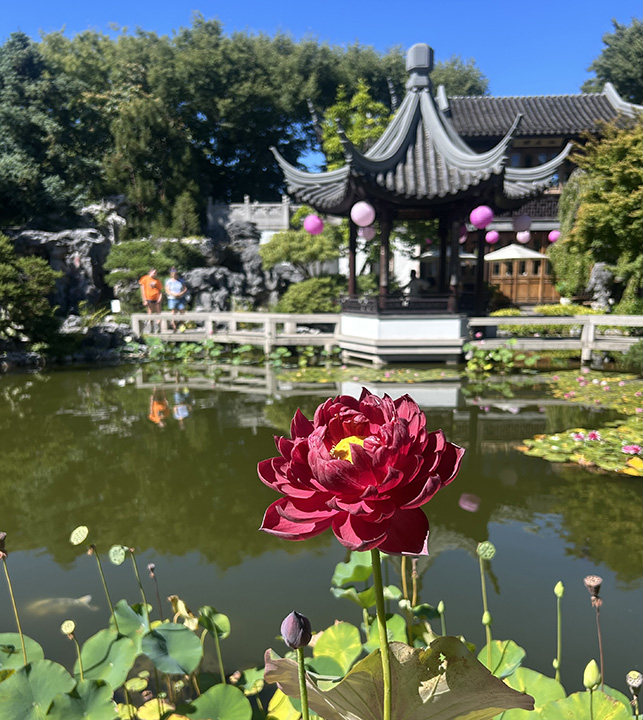
Above: Lotus nucifera ‘Mohong’ was a fan-favorite during The Lotus Festival this summer.
Did you notice? 处暑 (Chùshǔ) or “The End of Summer” as its known, touched down on August 23 this year. It is one of the 24 solar terms that makes up the ancient Chinese calendar based on Earth’s rotation around the sun. If you’re into astrology, you’ll know this as the start of Virgo season!
The dates of the solstices (longest and shortest days of the year) and equinoxes (the two dates a year with equal length of day and night) are dutiful markers in the change of the season of many cultures around the world that live in a temperate climate. But in ancient China, in addition to those pivotal dates, the calendar was subdivided into six “mini seasons” based on changes in temperature, precipitation, and growth in crops.
Interestingly enough, per the solar terms calendar, the start of fall 立秋 (lìqiū) arrives before the end of summer 处暑 (chùshǔ). As someone who is from a culture which does not call out the nuance of the “in between seasons,” this order actually makes a lot of sense. Come August 7 this year, although it was still very summery and hot, the inkling of fall was already in the air. We are innately programmed to sense these subtle changes in the natural world around us, even as we subjugate much of our waking moments to work behind computer screens and in air-conditioned buildings.

Luckily many of the beautiful moments lacing together the beginning of fall and end of summer are in the morning and evening. I encourage you to set your alarm fifteen minutes earlier, get outside on your porch or stoop and enjoy experiencing the slow descent into fall. (Ok, if you really can’t bear to sacrifice those precious moments of sleep, I hear you. Instead, set aside time to step outside at twilight and bask in the refreshing cool air and insect noise.)
The next terms to come upon us are 白露 (báilù) the “White Dew” and 秋分 (qiūfēn) the autumn equinox on September 7 and September 23, respectively. You may think that this ancient calendar has no modern relevance, but modern Chinese really do still pay attention to the rhythm of the seasons. Traditions around appreciating certain sceneries, plants in season, and seasonal delicacies are deeply rooted to the 24 Solar Terms.

In the month of September, I hope you find enjoyment in the sights and smells of the garden. In the last few moments of summer, it’s encouraging to think that our collection’s sweet osmanthus will soon be perfuming the air. Make sure to make a visit during our Mid-Autumn Festival from September 25-27. Falling right after the autumn equinox, it will be a perfect time to savor the slower pace of autumn but with dependably sunny weather!
See you around the garden soon,

Josie Losh
Curator of Horticulture
Lan Su Chinese Garden
Leave a Reply